
Last verified: 28 August 2026. All prices checked August 2026. What changed recently: Budapest taxi tariffs rose on 1 August 2026 and an 800 HUF airport fee was added; the 100E began running every 5–6 minutes at peak on 1 April 2026; since October 2025 holders of a Budapest-pass, Pest County Pass or Hungary Pass pay 1,000 HUF instead of 2,500 HUF on the 100E. Corrected on 19 August 2026: the tourist Budapest Card is not on BKK’s eligibility list and does not get the discount.
This post contains affiliate links. If you book through them we may earn a small commission at no extra cost to you.
The simplest way from Budapest Airport to the city centre is the 100E Airport Express bus: 2,500 HUF (~€6.30), around 40 minutes to Deák Ferenc tér, running 24 hours a day. The cheapest is the 200E bus plus the M3 metro at 1,000 HUF (~€2.50), but it takes about 55 minutes and involves a change. An official Főtaxi to the centre runs roughly 11,000–14,000 HUF (~€28–35) since the tariff rise on 1 August 2026. If you are landing with a large suitcase and want to go straight to a thermal bath, book a private transfer — and buy a cabin ticket, not a locker, when you get there.
That last point is the one nobody explains, so it gets its own section below.
Landing late, or with more luggage than hands? A pre-booked private transfer meets you at arrivals with your name on a board and a fixed price agreed before you fly, which removes the two things that go wrong at BUD: the taxi queue at 23:00 and the fare you cannot predict. Compare fixed-price Budapest Airport transfers →
How far is Budapest Airport from the city centre?
Liszt Ferenc International Airport (BUD) sits about 16 km south-east of the centre in a straight line, and 20–24 km by road. That gap matters when you are estimating a metered taxi fare. There is one passenger terminal complex, Terminal 2, split into 2A and 2B. Everything below leaves from the same place.
No metro line reaches the airport, and no railway station sits at the terminal. Anyone telling you to “take the metro from the airport” is describing a two-stage journey, not a direct one.
What are the options, and what do they cost?
| Option | Price (Aug 2026) | Time | Runs | Best for |
|---|---|---|---|---|
| 100E Airport Express | 2,500 HUF (~€6.30) | ~40 min | 24/7, every 5–6 min at peak | Most visitors, light luggage |
| 200E bus + M3 metro | 1,000 HUF (~€2.50) | ~55 min | 24/7 | Tight budgets, no rush |
| Official Főtaxi | ~11,000–14,000 HUF (~€28–35) | ~30 min | 24/7 | Groups of 3–4, door to door |
| Private transfer | Fixed, quoted at booking | ~30 min | Pre-booked | Late arrivals, big suitcases, going straight to a bath |
Prices checked August 2026. Taxi fares vary with traffic and destination — see the tariff maths below.
Is the 100E bus worth 2,500 HUF?
For most people, yes. It is the only direct public transport link, it runs all night, and 40 minutes with no change is worth the premium over the 200E. Since 1 April 2026 it runs every 5–6 minutes at morning and afternoon peaks, which is more often than most guides still say.
Three things catch people out.
Check what your pass actually is. The 100E needs its own airport ticket at 2,500 HUF. Since October 2025, holders of a valid Budapest-pass (the 15-day version excepted), Pest County Pass or Hungary Pass can buy a 1,000 HUF add-on ticket instead. The catch is that it is sold only in the BudapestGO app — not at machines, not at the desk. Download it before you fly.
The Budapest Card is a different thing, and this is where most guides get it wrong in both directions. It is the tourist card, and it does not cover the 100E. It is also not on BKK’s list of passes that qualify for the 1,000 HUF add-on. If that is what you are holding, budget the full 2,500 HUF. BKK does not say whether the 24-hour and 72-hour Budapest travelcards count as a “Budapest-pass” here either, so assume they do not until the app tells you otherwise.
It only stops three times. Coming from the airport you can get off at Kálvin tér, Astoria or Deák Ferenc tér, and nowhere else, in that order. Deák Ferenc tér is the terminus and the only station where the M1, M2 and M3 metro lines all meet.
It gets full. Buy before you board — BKK ticket offices in the terminals, the machines by the bus stop, the BudapestGO app, or contactless card on board.
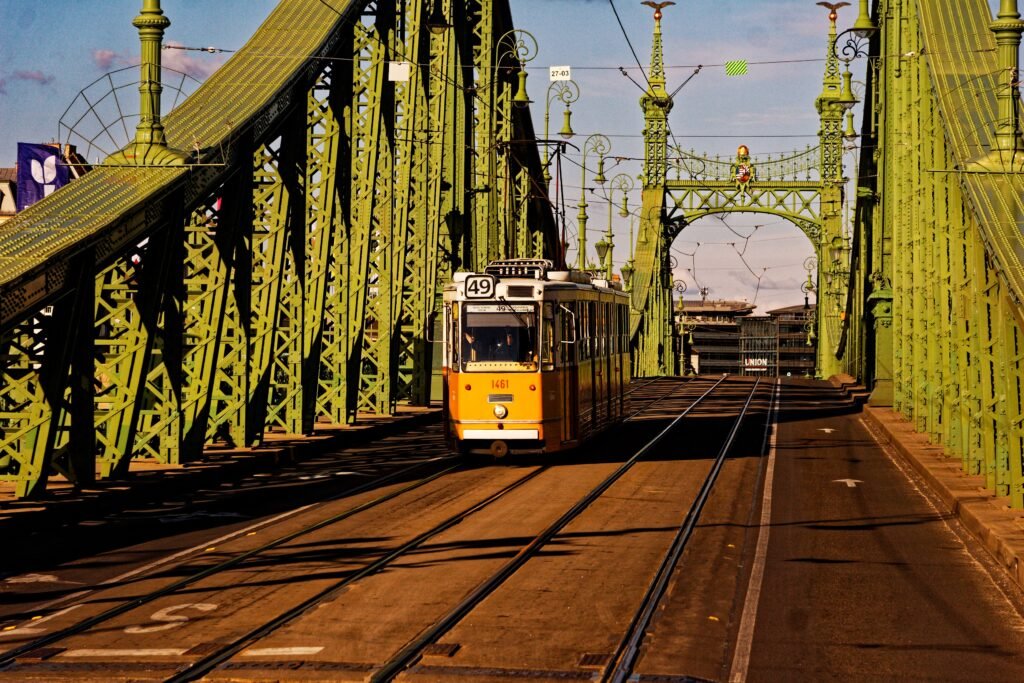
Standard BKK fares for everything else, checked August 2026: a single ticket is 500 HUF, a block of ten is 4,500 HUF, a 24-hour travelcard is 2,750 HUF and a 72-hour travelcard is 5,750 HUF. Buying a single on the spot instead of in advance costs 700 HUF.
Where is the 100E bus stop at Budapest Airport?
Outside on the arrivals level, in the bus bay between Terminals 2A and 2B. It is a short walk from either arrivals hall and no shuttle bus is involved. The 200E uses the same bay, so check the number on the front of the bus. Ticket machines stand beside the stop.
Budapest Airport’s own transport page places the stops on the arrivals level, between the two terminals. There is no separate 100E stand at 2A and another at 2B, which is where most of the confusion comes from: one bay serves both terminals and both airport bus lines. Checked August 2026.
When is the 200E plus metro the better call?
When you are saving money and not carrying much. The 200E runs from Terminal 2 to Kőbánya-Kispest, the southern terminus of the M3 blue line, and the metro takes you in from there. Two single tickets, 1,000 HUF total, about 55 minutes. At night the 200E runs on to Határ út instead.
The 200E does not require the airport shuttle ticket — it runs on ordinary BKK fares. That is the reverse of what most people assume, and it works in your favour. A block of ten brings the same journey down to 900 HUF, and a 24-hour or 72-hour travelcard covers the whole thing at no extra cost.
The M3 was rebuilt recently and now has lifts at its reconstructed stations, so this route is more manageable with a case than it used to be. It is still two vehicles and a transfer at the end of a flight.
How much is a taxi from Budapest Airport?
Roughly 11,000–14,000 HUF (~€28–35), checked August 2026. Főtaxi holds the official concession at BUD and its rank is directly outside arrivals. There is no zone or flat-rate system.
Budapest taxi tariffs rose on 1 August 2026, and most guides have not caught up. The current fare structure is a 1,300 HUF base fare, 520 HUF per kilometre and 130 HUF per minute, plus a separate 800 HUF airport fee on any journey to or from Liszt Ferenc. That means an airport ride starts at 2,100 HUF before you have moved. Pre-booking adds another 800 HUF. If a page quotes you 1,100 HUF base, 440 HUF per kilometre and a total around 10,800 HUF, it is showing the pre-August tariff.
Over 20–24 km of road plus waiting time in traffic, 11,000–14,000 HUF is the realistic range. If you read that a taxi to the centre costs 7,200 HUF, that figure is for a shorter inner-city journey and does not apply from the airport.
Only take a taxi from the official rank or a pre-booked transfer. Budapest Airport lists Főtaxi as the taxi service operating at the terminal; do not accept a ride from anyone approaching you inside the terminal (bud.hu, checked August 2026).
Can you go straight from the airport to a thermal bath with your luggage?
Yes, at Széchenyi — but only if you buy the right ticket.
This is the practical point every other guide buries. Széchenyi allows suitcases and large bags, and the bath itself recommends a cabin ticket rather than a locker if you are carrying one. The lockers are small: a backpack fits, a checked suitcase does not. A cabin is a private changing room, locked with the same wristband, and your case stays in it for your whole visit.
Two rules to plan around:
- Your ticket is valid for one entry only. Leave the building and you pay admission again. Everything you need comes in with you.
- Book the cabin option deliberately. A standard ticket with locker is cheaper and will not solve your luggage problem.
Gellért is not an option. It has been closed since October 2025 and is not expected to reopen until around 2028, with the hotel becoming a Mandarin Oriental in 2027. Any guide still recommending a post-flight soak at Gellért has not been updated.
Going straight from arrivals to City Park? Széchenyi is the right choice for a first visit — biggest, easiest to find, and the only one that comfortably takes a suitcase. Compare Széchenyi ticket and cabin options →
How do you get from the airport to each bath?
| Bath | Route | Time from BUD | Step-free? |
|---|---|---|---|
| Széchenyi | 100E to Deák Ferenc tér, then M1 to Széchenyi fürdő | ~60 min | No — M1 is the 1896 line, stairs at most stations |
| Rudas | 100E to Kálvin tér, then M4 one stop to Szent Gellért tér, then ~10 min walk along the embankment | ~60 min | Yes — every M4 station has a lift |
| Lukács | 100E to Deák Ferenc tér, then M3 to Nyugati, then tram 4 or 6 across Margit híd | ~70 min | Partly — M3 has lifts, the tram stop does not help |
| Gellért | Closed until ~2028 | — | — |
The M1 detail matters more than it sounds. It is the oldest metro line on the European continent, which means narrow stairways and no lifts at most stations. BKK does not list M1 among its accessible lines at all. With a 23 kg case, a transfer to the door is worth the money — or take the M4 route to Rudas instead and save Széchenyi for a day when your hands are free.
Rudas is worth a note of its own: check the schedule before you go, because the historic Turkish section runs gendered days, and the rooftop pool with the Danube view is the reason to bother.
Which should you actually pick?
- Travelling light, arriving in daylight — 100E. Nothing else is worth the extra cost.
- On a tight budget, small bag — 200E plus M3.
- Three or four of you — a taxi splits to roughly the same per-person cost as the bus, with none of the walking.
- Arriving after 22:00, or with a checked suitcase, or heading straight to a bath — private transfer. Fixed price, someone waiting, boot space.
Arriving on a late flight? A transfer booked in advance costs the same at 02:00 as at 14:00, which a metered taxi does not. Check fixed-price transfer rates for your flight →
Frequently Asked Questions
Is there a train or metro from Budapest Airport?
No metro, and no station at the terminal. A mainline station called Ferihegy sits about 1.5 km away on the Cegléd line, reachable by the 200E bus, with a roughly 25-minute run into the city. Trains are infrequent, so most people use the 100E instead.
Does the Budapest Card cover the 100E airport bus?
No. A full 100E ticket is 2,500 HUF, and the Budapest Card is not among the passes BKK lists for the discounted 1,000 HUF add-on. Those are the Budapest-pass (the 15-day one excepted), the Pest County Pass and the Hungary Pass, and the add-on is sold only in the BudapestGO app. With a Budapest Card, budget 2,500 HUF.
Can you pay by card on the 100E?
Yes. You can tap a contactless bank card on board, or buy in advance at the BKK offices in the terminals, from the machines by the stop, or in the BudapestGO app. Buying before you board is faster when the queue builds.
Can you take a suitcase into Széchenyi Baths?
Yes, but buy a cabin ticket rather than a locker. The bath’s own guidance is that lockers hold a backpack, not a checked case, and that cabins are the option for suitcases. A cabin is a private changing room locked by your wristband. Your ticket allows one entry only.
How much is a taxi from Budapest Airport to the centre?
Roughly 11,000–14,000 HUF (~€28–35), checked August 2026. Since 1 August 2026 Főtaxi charges a 1,300 HUF base fare, 520 HUF per kilometre and 130 HUF per minute, plus an 800 HUF airport fee. Pre-booking adds 800 HUF. Older quotes of around 10,800 HUF use the previous tariff.
Is the 100E bus safe at night?
Yes. It runs 24 hours a day, roughly every 30–40 minutes overnight, and is used by locals as well as visitors. The usual city-centre awareness applies at Deák Ferenc tér late at night, as it would in any capital.
Read next: The best thermal baths in Budapest · Széchenyi Baths: the complete guide · Thermal bath etiquette in Budapest · Is Budapest safe for tourists? · All planning guides